
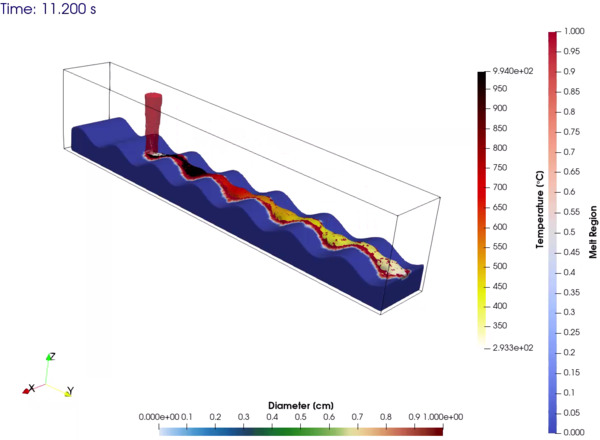
Directed energy deposition (DED) is widely used to build and repair large metal parts for aerospace, automotive and tooling applications, but the height and shape of each deposited layer drift as the melt pool responds to changes in the part below it. In collaboration with Missouri University of Science and Technology, the NDML uses multiphysics simulations of Inconel 718 deposition to understand these dynamics. The models capture multiphase flow, heat transfer, solidification, surface tension and Marangoni effects, and are used to study how laser power, scan speed, standoff distance and substrate geometry affect melt pool size and deposit height. Current work drives the process with sinusoidal substrate disturbances to measure its frequency response, which will form the basis for a model-based height controller.
The figure above shows a simulated deposition track over a wavy substrate.