
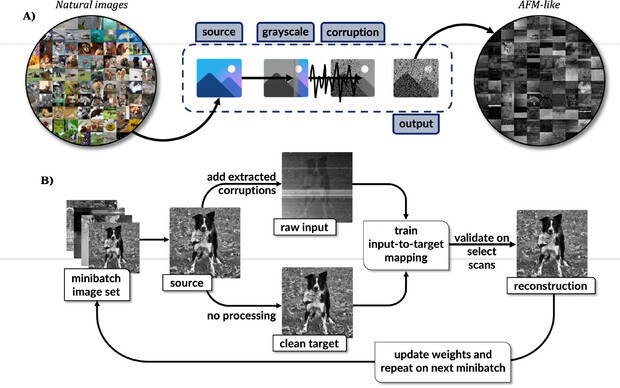
Atomic force microscopy (AFM) provides nanometer-scale topography, but high-quality scans are slow and require careful manual post-processing, which limits the use of AFM for in-line metrology. In collaboration with Sandia National Laboratories, the NDML has developed machine learning methods that reconstruct high-resolution images from fast, noisy scans. Our first approach used a Noise2Noise-style U-Net to recover the quality of slow scans from data taken nearly three times faster. Building on this, AFM-net trains on large sets of natural images corrupted with artifacts extracted from real AFM data. This overcomes the scarcity of AFM training data and lets a single model correct line noise, tilt and scars while predicting feature heights. The approach processes each scan in seconds rather than minutes and also generalizes to scanning tunneling microscope images.
The figure above shows the AFM-net training workflow.