
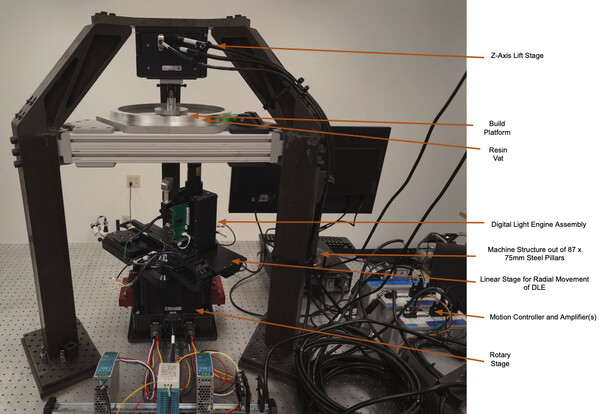
Large telescope and satellite mirrors are expensive and slow to make because they require extensive grinding and polishing. The NDML is developing a projection micro-stereolithography system that prints optical surfaces directly. The system uses an r–θ motion architecture, in which a rotary stage and a radial linear stage move a digital light engine beneath the resin vat, so that a small, high-resolution projection field can cover a build area much larger than the field itself. Replacing the polymer film at the bottom of the vat with a rigid quartz constraint surface reduced the printed surface roughness from several microns to tens of nanometers. The goal of this work, carried out in collaboration with Triton Systems, is a scalable process for printing large-diameter optics with nanometer-scale surface finish.
The figure above shows the completed r–θ printing system.