
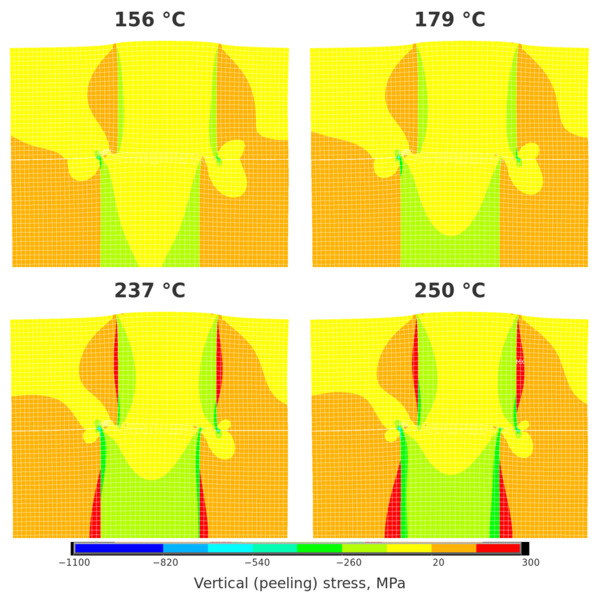
Hybrid bonding joins copper pads and oxide surfaces directly, enabling interconnect pitches of a few microns and below. However, the bond forms at a buried interface that cannot be inspected until after anneal, and failures are costly and irreversible. The NDML is building a digital twin that predicts bond quality before dies are joined. Pre-bond metrology such as AFM topography and copper dishing profiles sets the starting conditions for a set of linked simulations: molecular dynamics of the oxide–oxide and copper–copper interfaces, phase-field models of void closure and grain growth during anneal, and finite element models of die-scale stress and alignment. Machine-learned surrogates of these models are calibrated against test-vehicle data to create a virtual metrology layer that can guide process decisions as wafers move through the line.
The figure above shows a finite element model of a Cu–SiO2 hybrid bond with a 20% copper pad misalignment, with vertical (peeling) stress building at the Cu–SiO2 transition corners as the anneal ramps from 156 °C to 250 °C.