
Recovering critical elements such as cobalt, nickel and lithium from batteries and industrial waste requires sorbents that combine a large surface area with fast flow. The NDML uses digital light processing to print gyroid structures with pores at two length scales: the gyroid geometry provides open millimeter-scale channels for flow, while polymerization-induced phase separation creates nanometer-scale pores within the walls. By changing the porogen mix in the resin and the wall thickness, we can trade off diffusion rate against mechanical strength. Receptor molecules bound into the porous walls allow selective capture and fast release of target metals, and the printed cartridges fit into a modular flow platform that can be reconfigured for different separations.
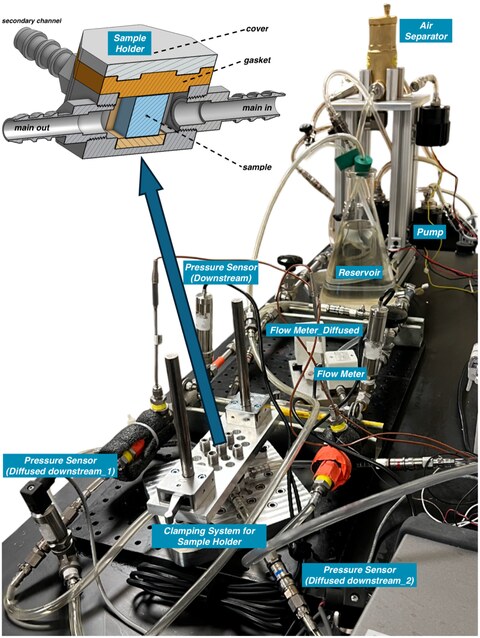
The figure above shows the flow test system used to measure pressure drop and diffusion through the printed gyroids (from Gao et al., Advanced Engineering Materials, 2026, CC BY-NC-ND 4.0).